EP 12.《Learning in Nature: Real Documentary of My Exchange Life》
Cross-Cultural Exchange: Finding a Lifeline in Exchange Life
After a series of turbulent wanderings, the new semester was finally about to begin. I joined the university’s Welcome Week with my roommates, where groups were divided by nationality and region. My group was almost entirely Asian, with a South Korean majority; I was the only Taiwanese person. Initially, being in such an international, cross-cultural environment felt a bit unsettling. A guy from Australia in our group, Chap, took the initiative to chat with me. Having lived in China before, he could speak some basic Mandarin. He was the only Australian among the exchange students and, having left his Norwegian friends, he had found in me another “lifeline” to hold onto. We were in the same faculty and would occasionally grab a drink after class. He even gave me his extra fabric softener—he was definitely one of my best friends during that first semester.
Through the group activities, I got to know many South Korean friends and gained a deeper understanding of their culture. Many of them are accustomed to completing their military service before attending university. The men there have to serve for two years—by comparison, Taiwan seems more precarious yet only requires four months or a year of service, though I believe few people actually enjoy being in the military. After spending a few days with them, I learned how much they value age and seniority, which is reflected in the use of honorifics in their language. However, they become incredibly exuberant when eating or drinking. After traveling with other exchange students and attending parties, I realized that most people know about Taiwan and are generally very supportive. Even my friends from Georgia explicitly stated that they view Taiwan as an independent country, even if their government doesn’t officially recognize it.
Nature as a Classroom: Fieldwork with Norwegian Roommates
My Norwegian roommates and I took many of the same classes; Solvei’s schedule and mine were almost identical, as we both selected courses related to the environment and sustainability. One class, called Global Ecology, had only three students. It was a mix of in-person and online sessions, with occasional field trips. These school excursions are undoubtedly the most valuable resources for exchange students, offering access to areas that the general public cannot easily reach. Our professor, Peter, once drove us to the famous limestone cave in Brno, Jeskyně Jáchymka, and even took us to his home for tea and a lesson—it was a remarkably “natural” residence. I never imagined having such an eccentric and interesting professor who would bring students directly to his home for class.
Later, we visited Podyjí National Park (Národní park Podyjí), where the professor introduced us to the flora and fauna of the Czech Republic. Seeing wild deer roaming through the mountains was an incredible experience for a nature lover like myself. We then crossed the Dyje River to the Austrian border town of Hardegg before crossing back into the Czech Republic. We foraged for mushrooms in the forest and boiled them at home to use as pasta toppings—a sense of “daily life” I had never experienced before.
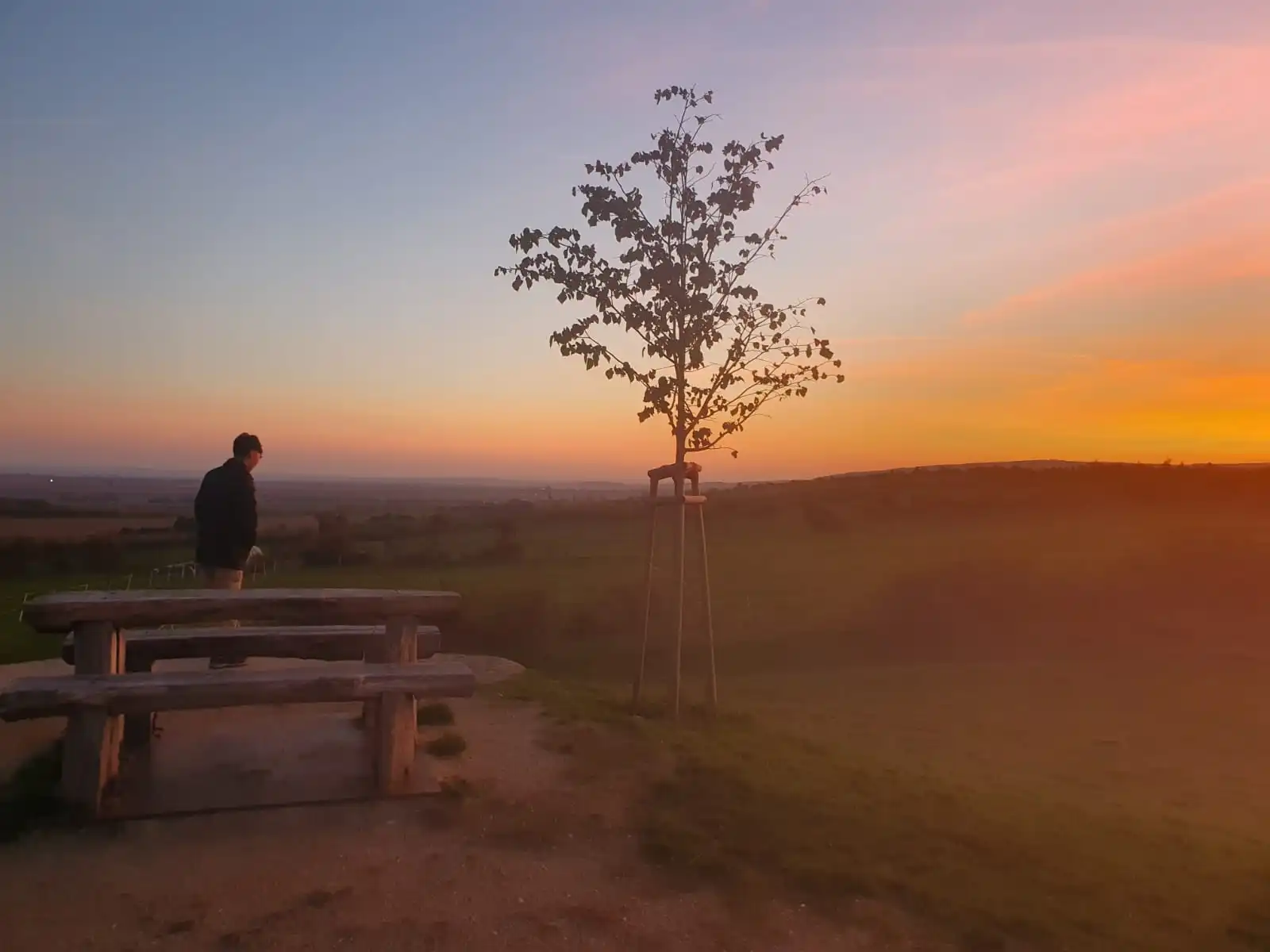
Another of my favorite spots is the Hády Quarry landscape protected area, which a professor from an environmental protection course introduced us to. It features unique natural terrain, somewhat like Mediterranean shrubland, and offers a panoramic view of Brno and a vast expanse of nature. There is even an alpaca farm nearby; overall, it is a very special area in terms of both landscape and ecology. Whenever friends come to visit, I always take them there.
A Soliloquy in Midnight Brno
I remember before I arrived in the Czech Republic, my local buddy, Teru, told me never to walk the streets alone after dark because it could be dangerous. Once, my Norwegian roommates and I went to a student party. I left early, around 1:00 AM, and because the night trams were infrequent, I decided to walk an hour home. That was the first time I realized just how “safe” it felt to walk alone in the middle of the night.
While crossing the street against a red light, I got a mild scolding from a Czech elderly man, even though the locals often jaywalked themselves. I stopped at the Světelná fontána ve tvaru opony (the Curtain Light Fountain), an installation art pool in the Old Town. It uses shifting colored lights to illuminate falling water droplets, interpreting the current temperature and date into a water show. I sat quietly by the pool for over ten minutes, not feeling the slightest bit of danger.
Near the central train station, I saw groups of drunkards and homeless people lying on the ground. The startling sight made me quicken my pace, fearing they might suddenly wake up and attack me. This was a path I walked every day to and from school, and every day I encountered homeless people—men and women alike—relieving themselves by the roadside. My initial fear eventually turned into understanding; they are simply living in a different world from ours. I often saw the police checking on them and frequently heard the sirens of ambulances and police cars, or even saw police cordons in the city center, yet I never felt that these dangers threatened me personally.
I wondered: if even the locals think it’s dangerous to walk at night, how is it that I, as an outsider, transitioned from a sense of urgent threat to feeling adapted and at ease? Is it because I don’t know enough, or is it actually not that dangerous?
As winter approached, the homeless gradually disappeared from the central station. I wasn’t sure where they went to escape the cold, but I imagine they lived quite freely in their own world, because “no one really cared about them”.