EP 8. Wandering Across the Sea Under a Purple Afterglow: When Regret Becomes a Destined Tenderness
Nordic-Exclusive Purple Tenderness: Island Hopping from Tallinn to Helsinki
After a fulfilling day at the beach, the unique purple afterglow of a Nordic summer felt incredibly decadent. Following a brief rest, I prepared to board the ferry and formally cross the Gulf of Finland toward Helsinki.
I was packing my bags at a leisurely pace, only to realize I had actually confused the ferry schedule with a flight time, causing me to miss the morning departure. Due to fluctuating ticket prices, I quickly booked a 5:30 PM slot and spent the rest of the day “rotting” at the hostel until it was finally time to stroll toward the harbor. It had been a long time since my last seafaring experience; I expected something like the passenger boats from Taiwan to Penghu, but the vessels here are cruise-ship grade—grand five-story hulls where the decks and seating areas were packed nearly to capacity. This three-hour voyage is a daily routine for locals; I heard many Finns make the trip to Tallinn specifically to stock up on cheap alcohol, a unique spectacle born from the price disparity between the two regions.
I found a prime spot on the third-floor deck, braving the sea breeze while snacking on my prepared bread, green grapes, and milk. Despite the bright sun, the Baltic sunlight is intense yet lacks warmth; the wind chill was so biting I had to layer a down jacket under a windbreaker to stay warm. Later, I moved to the forward deck, propped my hiking pack against the hull as a pillow, and drifted off to sleep to the rhythm of the waves.
Just before arrival, the silhouettes of islands began to emerge on the horizon. The golden sunset burst across the water like a flashbang, carving a path of shimmering light. Watching seagulls circle and geese drift on the water, it felt as though the entire North Sea was welcoming me to Helsinki. One particularly grand archipelago (Suomenlinna) caught my eye, and I made a mental note to explore it in the coming days.
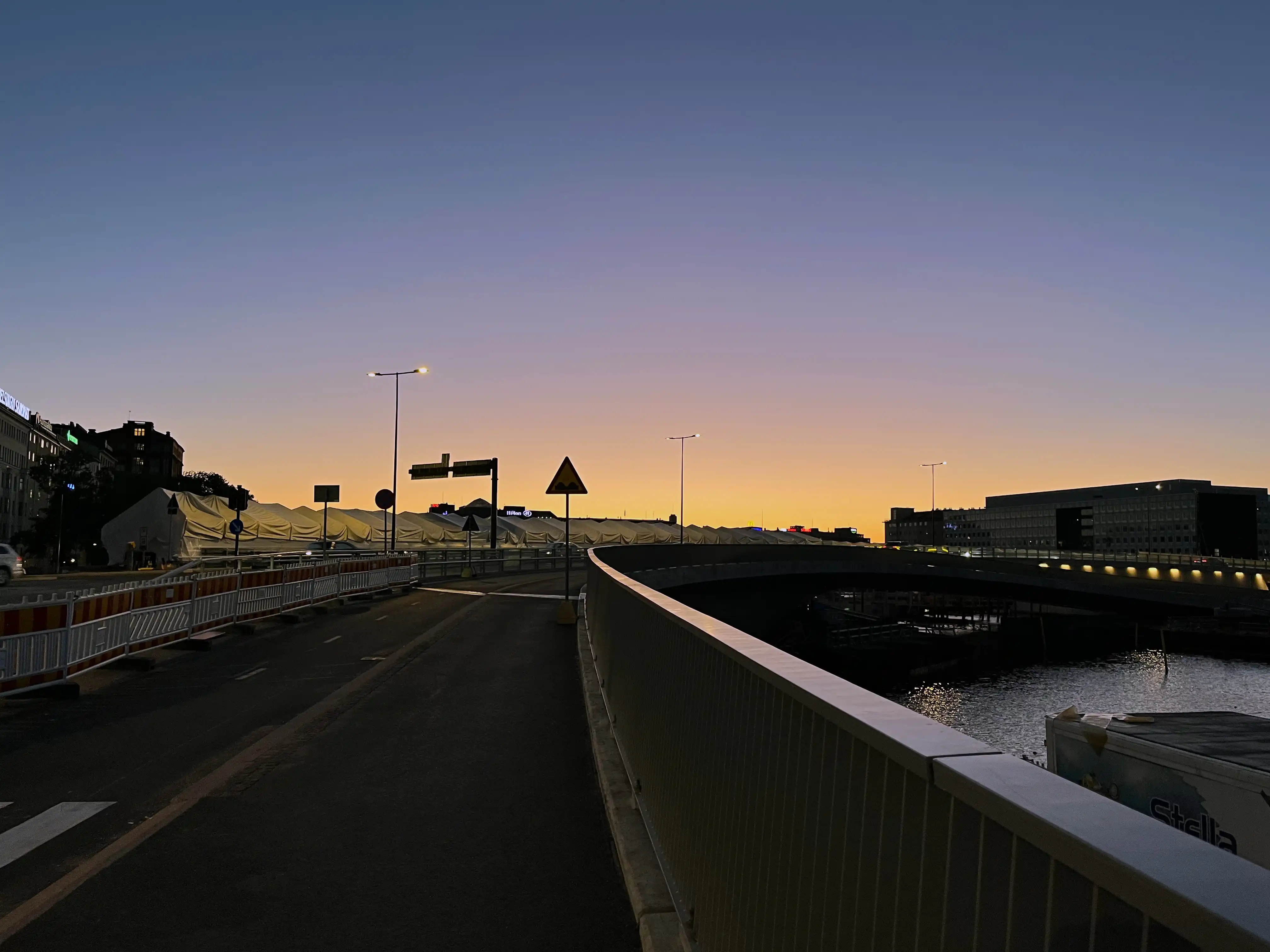
As I continued north, accommodation prices climbed steadily; even the most basic 16-bed dorm in Helsinki cost 20 Euros and required an hour’s walk from the port. Fortunately, the purple sunset unique to high latitudes diluted that sense of loneliness. The city is quiet to the point of feeling empty; there is traffic, but one would never describe the atmosphere as “bustling”. That pastel-purple sky, which in Taiwan only appears before a typhoon, is a daily occurrence here—perhaps the most extravagant gift high latitudes offer a traveler.
African Cuisine in Helsinki and Survival Tips from a Chinese Peer
After arriving at the hostel, I first stopped by the supermarket next door for some green grapes and tried to find a spot in the massive common area. Contrary to the silent facade of Helsinki’s streets, the hostel kitchen was bustling to the point of boiling over. A long table seating dozens was mostly occupied by African travelers who were simmering a large pot of sauce and cooking fragrant jollof-style rice with drumsticks; in comparison, the yogurt and grapes in my hands felt a bit humble.
On the other side, where a group of Japanese travelers had settled, it was so crowded I couldn’t find any space, so I chose to sit near the African group instead. These men came from various countries like Nigeria and Kenya. Though their native tongues differed, “African English” served as their lingua franca. One Nigerian master’s student had been living in the hostel long-term because he simply couldn’t find an apartment to rent. Soon, a friendly young man struck up a conversation and naturally joined us. He was a Chinese student in his final year of nursing school in Finland; he had moved to Helsinki to write his thesis and seemed to be on very familiar terms with the African residents.
When the rice was ready, they generously shared a bowl with me and the Chinese guy, topped with their traditional sauce and even a chicken drumstick. It suddenly hit me that I hadn’t eaten “rice” for ages since arriving in Europe—without a rice cooker, I honestly had no clue how to prepare it. I never expected my first taste of African cuisine would be in Helsinki, Finland; that warm bowl of “African flavor” was exactly what my parched “Asian stomach” needed. During the meal, a guy from Kenya proudly showed off his Irish passport—the piece of paper that allows him to travel freely across Europe and reside in Finland long-term. Because Finland is relatively open and foreigner-friendly, many African immigrants make a living here driving taxis or doing food delivery.
Once the meal ended, it was just me and the Chinese student chatting in Mandarin. He shared that while Finnish tuition isn’t as expensive as one might imagine, the high cost of living and the severe housing shortage are the true survival challenges. Yet, for many, this level of freedom is worth the struggle. When I asked why there are always so many Japanese tourists in the Baltic states and Finland, he recommended the movie Kamome Diner (Seagull Diner) and told me that was his reason for coming to Finland. Before we parted ways, he shared a wealth of survival strategies, from local transport apps to the food-saving app “Too Good To Go.” However, for an “ultimate budget traveler” like me, even those discounted meals and transport options still felt like a bit of a luxury.
Suomenlinna: A Sunny Picnic Atop War Ruins
The next day, I walked an hour across the city, capturing the streetscapes of Helsinki along the way. Yet, my mind was fixated on that mysterious island I had glimpsed from the ferry the day before—Suomenlinna. Knowing very little about what to expect on the island, I used “Too Good To Go” to snag a burger and stopped by a supermarket for donuts and milk, ensuring I wouldn’t go hungry on that military outpost. I then bought a ticket and boarded a smaller ferry; this time, the experience felt much more like the boat trips to Taiwan’s Penghu islands.
Suomenlinna is a sea fortress situated off the coast of Helsinki. During the Swedish era, it was known as Sveaborg(meaning “Swedish Castle”), originally built to defend against the expansion of the Russian Empire. In the early 19th century, during the Finnish War, the fortress surrendered to Russian forces, marking the beginning of over a century of Russian rule. It wasn’t until Finland gained independence in 1918 that it was renamed Suomenlinna (“Castle of Finland”), symbolizing the return of sovereignty and national resilience.
The fortress is comprised of several small islands, the main ones connected by bridges and easily accessible on foot. Starting from Iso Mustasaari, where the port is located, I walked halfway around before crossing into Susisaari, which houses most of the historic sites, cannons, and museums. Walking along the trail, I felt as though I were hovering on the edge of centuries-old warfare—bound by the boundless sea on my left and cold, iron cannons on my right. It was a striking contrast: the once-grim battlements are now filled with people lounging in the sun and enjoying leisurely picnics. Seeing such tranquility today, I felt deeply fortunate to stand in a place once defined by such turmoil, but now as a mere traveler.
In the decadent light of a Nordic summer night, I spent a peaceful hour walking back to the hostel, savoring the unique tenderness of the North alone. From the initial regret of missing my ferry on day one to the profound contentment of watching the sunset tonight, it felt as though every “destined regret” was simply leading me toward a better path ahead.