EP 7. Reunion at the Turning Point of Time: Unlocking the Baltic Mystery
The Pasta Prelude: Debating Education and Empires at Linnahall
After hours of being washed over by music, I felt my soul slowly piecing itself back together. Back at the hostel, I cooked a large pot of sausage pasta, preparing enough to cover my lunch for the following day as well.
Around noon the next day, as I was enjoying that “rough” pasta, a German guy struck up a conversation. He had some critiques regarding my lunch—admittedly, it was just fusilli with meat sauce and sausage, as carrying fresh vegetables is inconvenient while traveling. I supplemented my nutrition with green grapes and a cup of homemade milk tea. Perhaps it was this unique recipe that opened the floor for conversation; he invited me to walk with him that afternoon. I usually don’t initiate meetups, but I am always happy to embrace the unknown when it comes to these unexpected invitations.
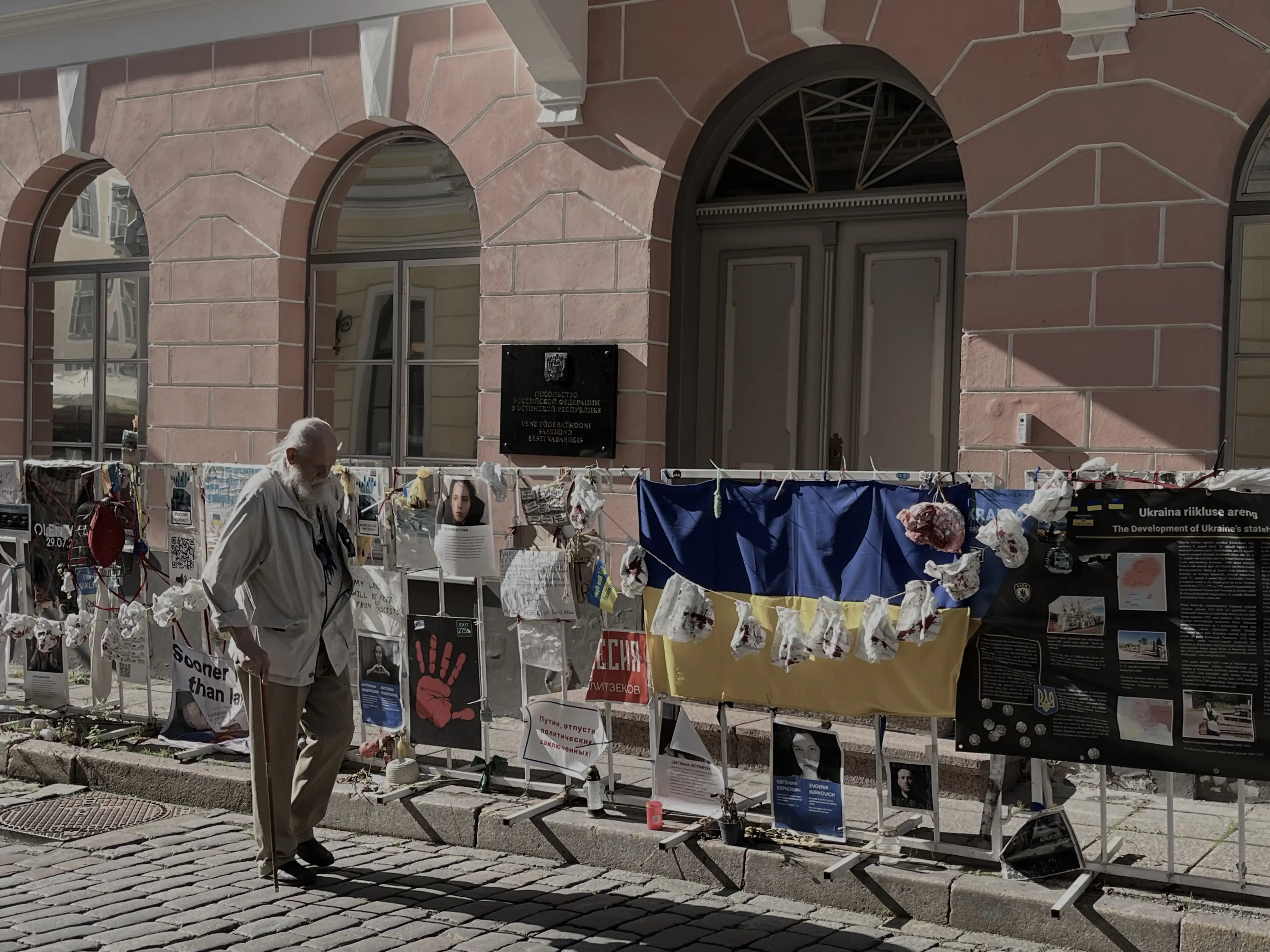
He was a German university student studying sociology, which inevitably led the conversation toward the intricate relationship between China and Taiwan—a topic he found particularly fascinating given his field of study. We talked as we walked, and I led him back to the viewing platform I had visited the day before; it was still afternoon, and the guitarist had not yet appeared. We did a circuit of the city’s landmarks—the Tallinn Town Hall, churches, and museums—but the place where we lingered longest and which left the deepest impression was the Russian Consulate.
The Baltic states all share the dim history of the Soviet era and a collective historical trauma; consequently, the political inclination of all three nations is pro-Western and anti-Russian. Estonia gained independence in 1918, but under the context of the 1940 Molotov-Ribbentrop Pact, the Soviet Union forcibly occupied and annexed the country, interrupting its national sovereignty. Today, due to the war in Ukraine, the consulate has been closed for some time. A massive Ukrainian flag hangs on the railings outside the Russian Embassy, looking both ironic and inspiring. White cloths and garments stained with red dye symbolize the blood of civilian victims in the war. Not only that, but the fence is covered with photos of captured or missing Ukrainian soldiers and civilians, alongside various anti-war slogans—forming Estonia’s heavy, silent protest against Russia.
Next, we walked out of the Old Town toward the filming location of TENET—the Linnahall Heliport. It has been abandoned for a long time and is overgrown with weeds; it lacks the epic feel of the movie but gains a sense of desolate ruin. We sat on the side facing the sea, continuing our exchange regarding the Taiwanese and German education systems.
Their semester generally begins in mid-to-late October, so he still had over a month of travel left. Their sense of identity regarding their national language is very high; if a course is chosen to be taught in German, the presentations and exams are strictly in German. In contrast, in Taiwan, “English-taught” courses often aren’t fully in English, while Chinese-taught courses are frequently interspersed with English—trying to internationalize by aligning with the West, but resulting in something neither here nor there. Regarding language acquisition, even if they are accustomed to German instruction, they encourage the application of language in daily life, allowing them to achieve better results in less time—or perhaps they have simply integrated learning into their lives over a long period.
To put it kindly, the people teaching me English in school have studied it for decades; on the flip side, it took them decades just to learn English. I feel like the amount of spoken English I’ve used in these few days of travel has already exceeded what I’ve spoken in my entire life. The summer afternoon in Tallinn remained hot, and mid-conversation, a sudden whiff of cannabis drifted up from the steps below. As we talked about it, I realized I had previously learned the word “Marijuana,” but here, everyone calls it “Weed”. These living expressions are things textbooks never teach.
The Ukrainian Invitation and the Baltic Resolution
The scent of “weed” drifting up from the steps became too pungent, so we headed back to the hostel for a quick break. Remembering the sand volleyball courts I’d spotted near Linnahall, I decided to return to the beach that evening. There, I unexpectedly joined a team of middle-aged Ukrainian men. I realized then how many Ukrainians are living across Europe; yet, the way they radiated a fierce “living in the moment” energy made it impossible to sense any heavy burden of worry. I couldn’t help but wonder: what do they feel when they see their national flag draped over the gates of the Russian Embassy? If I saw the Taiwanese flag displayed in another country as a sign of support, I know I would be deeply moved.
On the court, no one was particularly skilled, but the joy was infectious. One uncle even accidentally spreaded sand into my eyes while catching the ball. After losing the first set, they abruptly invited me to play table tennis—they even had their own paddles ready! It was all so sudden, but we ended up battling it out on stone tables right there on the beach. My German friend from earlier joined in, and this international match roared on until every single ping-pong ball had cracked. We ended the night in a chorus of laughter and satisfaction.
Unlocking the Baltic Enigma
The day felt like a series of scattered moments, but isn’t that just how life moves forward? I woke up with no plans, eating my leftover sausage pasta, met the German guy in the kitchen, and ended up wandering the Old Town and the cinematic ruins of Tenet.
I’ve realized that as I move forward through time, those coming from the opposite direction are simply following their own timelines. These chance encounters between travelers are like the “time inversion” in Tenet—a fated convergence at a specific coordinate in the world. This was my final stop in the Baltics, and I finally understood why that Hong Kong girl loved this place so much. It was also while trying to exchange WhatsApp info with my German friend that I realized a small technical detail: saving a number doesn’t always trigger an automatic “add.” This tiny discovery suddenly released a long-held knot in my heart. You were heading south, and I was heading north; we crossed paths for a fleeting moment. The regret I left behind in Budapest was finally set free. I see now that not every meeting is a prelude to a goodbye. Some people are just waiting for the next “inverted” reunion.