EP 7. Reunion at the Turning Point of Time: Unlocking the Baltic Mystery
The Pasta Prelude: Debating Education and Empires at Linnahall
It was a simple bowl of sausage pasta that opened the door to a profound afternoon. A German sociology student, intrigued (and perhaps a bit concerned) by my minimalist lunch of pasta, grapes, and milk tea, invited me to explore Tallinn with him.
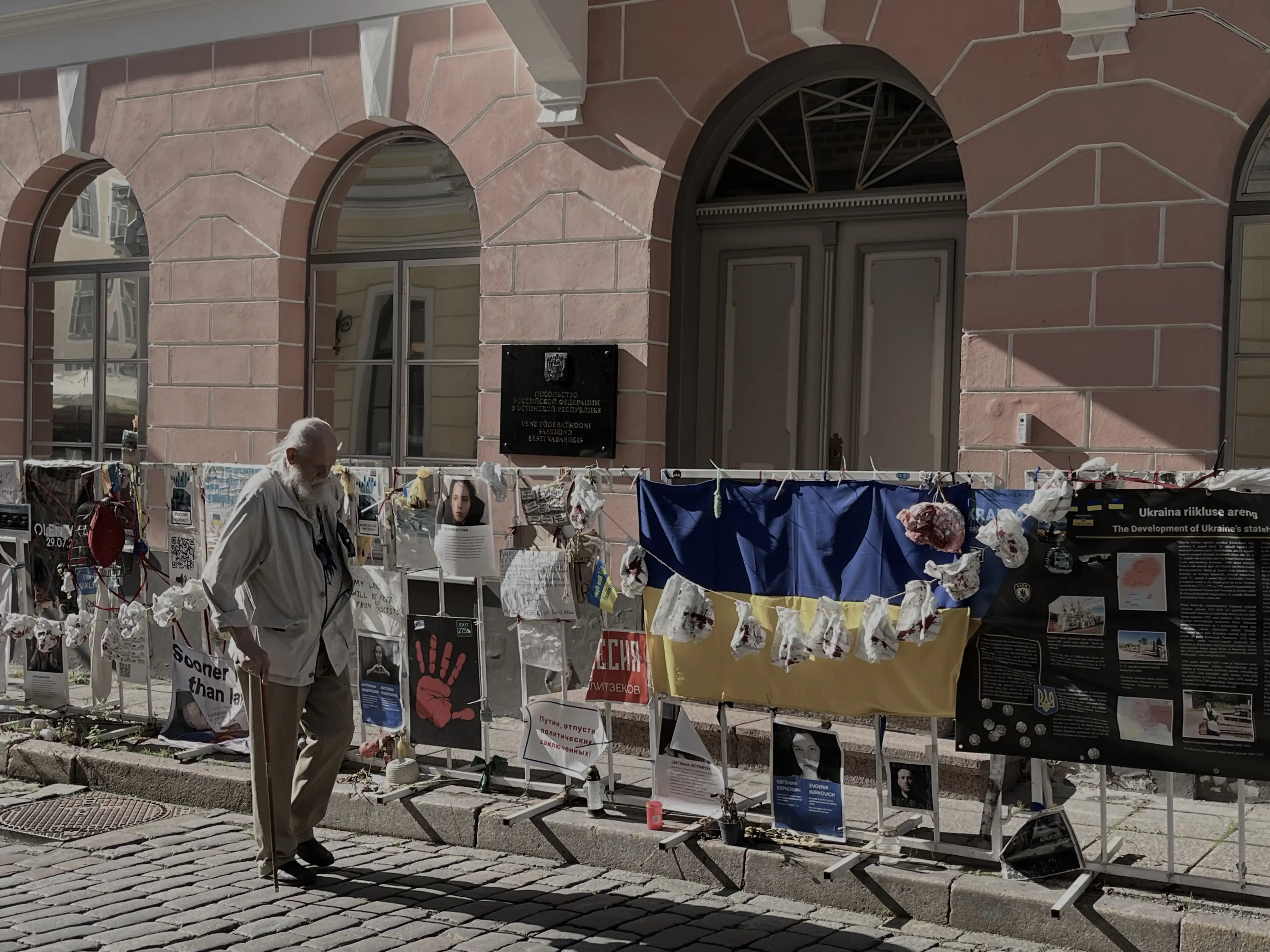
Our walk took us through the medieval heart of the city, but the most striking stop was the Russian Embassy. The gates were a gallery of silent resistance: Ukrainian flags, blood-stained white linens, and the haunting faces of the missing. It was a visceral reminder of the shared Baltic history of occupation and their unwavering support for sovereignty.
We eventually made our way to the brutalist remains of Linnahall, the “Tenet” filming site. The concrete was cracked and reclaimed by weeds, a stark, desolate backdrop for our discussion on education. We compared the German commitment to linguistic purity in universities with Taiwan’s somewhat confused “internationalization” efforts. He observed that for Europeans, language isn’t a subject to be mastered over decades—it’s a tool integrated into the rhythm of life.
I realized then that my few days on the road had taught me more practical English than years in a classroom. As the smell of “weed”—a word far more common here than the “marijuana” of my textbooks—wafted through the summer air, I felt the gap between academic learning and real-world existence finally beginning to close.
The Ukrainian Invitation and the Baltic Resolution
The scent of “weed” drifting up from the steps became too pungent, so we headed back to the hostel for a quick break. Remembering the sand volleyball courts I’d spotted near Linnahall, I decided to return to the beach that evening. There, I unexpectedly joined a team of middle-aged Ukrainian men. I realized then how many Ukrainians are living across Europe; yet, the way they radiated a fierce “living in the moment” energy made it impossible to sense any heavy burden of worry. I couldn’t help but wonder: what do they feel when they see their national flag draped over the gates of the Russian Embassy? If I saw the Taiwanese flag displayed in another country as a sign of support, I know I would be deeply moved.
On the court, no one was particularly skilled, but the joy was infectious. One uncle even accidentally kicked sand into my eyes while diving for a ball. After losing the first set, they abruptly invited me to play table tennis—they even had their own paddles ready! It was all so sudden, but we ended up battling it out on stone tables right there on the beach. My German friend from earlier joined in, and this international match roared on until every single ping-pong ball had cracked. We ended the night in a chorus of laughter and satisfaction.
Unlocking the Baltic Enigma
The day felt like a series of scattered moments, but isn’t that just how life moves forward? I woke up with no plans, eating my leftover sausage pasta, met the German guy in the kitchen, and ended up wandering the Old Town and the cinematic ruins of Tenet.
I’ve realized that as I move forward through time, those coming from the opposite direction are simply following their own timelines. These chance encounters between travelers are like the “time inversion” in Tenet—a fated convergence at a specific coordinate in the world. This was my final stop in the Baltics, and I finally understood why that Hong Kong girl loved this place so much. It was also while trying to exchange WhatsApp info with my German friend that I realized a small technical detail: saving a number doesn’t always trigger an automatic “add.” This tiny discovery suddenly released a long-held knot in my heart. You were heading south, and I was heading north; we crossed paths for a fleeting moment. The regret I left behind in Budapest was finally set free. I see now that not every meeting is a prelude to a goodbye. Some people are just waiting for the next “inverted” reunion.