EP 6. At the Peak of Europe's Silicon Valley: Meeting the Guitarist Who Rejected the World
Tallinn: Where Medieval Cobblestones Meet Digital Pioneers
On the way to Tallinn, Estonia, I experienced my first police checkpoint. Officers boarded the bus and flipped through everyone’s passports; fortunately, everything went smoothly. Tallinn is renowned for its digitalization and startup culture—processes like voting and daily administrative tasks have long been digitized. I had heard that free Wi-Fi blankets the entire city. Skype, a nostalgic icon for an entire generation, is a product of Tallinn’s startup scene, as is Bolt, which I had used back in Vilnius. The memory of frantically downloading Bolt just to catch a bus on an e-bike still feels utterly absurd.
Compared to Vilnius and Riga, Tallinn appears much more bustling and advanced, radiating a vibrant, youthful energy. On the walk from the station to the hostel, high-rises and parks coexist harmoniously. Passing through the Viru Gate, I entered the cobblestone-laden Old Town. “Quite a few tourists here," I noted with a slight smile. The most iconic feature of Viru Gate is its pair of cylindrical red-brick towers, topped with steep, conical roofs. These towers were once part of a massive 14th-century defense system; today, they serve as the gateway between the historic Old Town and the modern city center.
The Eerie Guitarist on the Overlook
My hostel was tucked away in the heart of the Old Town, part of a graffiti-styled bar—or perhaps it was a bar that happened to have a hostel attached? I couldn’t quite tell. As sunset approached back in Taiwan, I climbed the stone steps to the Patkuli Viewing Platform on the north side of Toompea Hill. Here, the sky was still broad daylight, not even close to golden hour. I lingered there for a long time, leaning against the railing to quietly witness the shifting hues of the northern sky.
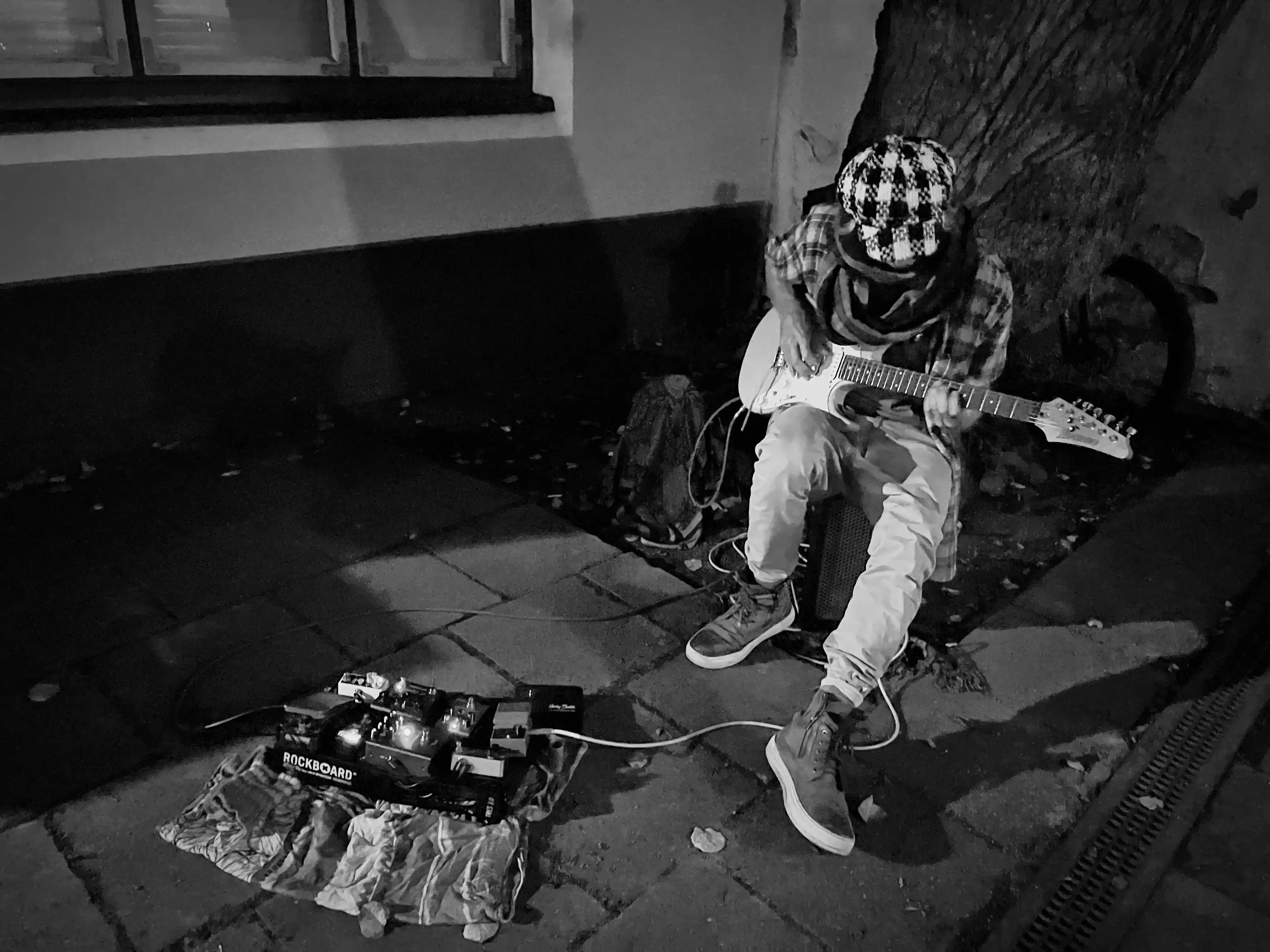
A street performer was playing electric guitar near the platform. He looked peculiar—a disheveled, bohemian figure radiating an air of untamed artistry. With a thick scarf over a flannel shirt and earth-toned layers topped with a checkered cap, he embodied the quintessential street artist aesthetic. Yet, no one seemed to be paying him any mind.
His aura was so eerie that I didn’t dare look him in the eye. He would occasionally steal glances at the passersby, while I stared at the horizon, pretending to admire the view while actually listening intently. His music was unique and incredibly atmospheric. Eventually, an older woman approached and started chatting with him right as he was recording a loop. If it were me being interrupted during a loop recording, I’d probably be annoyed, haha. But I took the opportunity to lean in and inspect his pedalboard; I was dying to see how he structured his ambient effects. His style was hard to define—initially, I analyzed it as a Neo-soul foundation blended with blues techniques and heavy spatial processing.
Unlike the bustling streets below, the platform remained relatively empty. Once the woman left, it was just him, me, and a few others scattered about. As I listened, he began explaining the function of each pedal and how he used the looper to build a one-man band with drums and bass. He seemed to truly relish the solitary joy of experimenting with those sounds and combinations.
Soul Echoes on the Viewing Platform: The Guitarist Who Broke the Mold
I was curious why he didn’t play in the bustling city center, where more crowds would mean better tips. That’s when he told me his story. A Tallinn local, he was once a manager in the forestry industry. He had learned acoustic guitar in university but set it aside for his career. At 34, he bought his first electric guitar—the very Ibanez he was holding. For four years, he practiced obsessively, and a year ago, he resigned to embrace a life on the road. “This is exactly the life I long for,” I thought. In that moment, our conversation struck a deep chord.
Behind his current ideal life, however, lay the pain that pushed him toward it. He loathed the local political culture and the societal molds—the mundane, repetitive jobs, and the relentless pursuit of conventional success and fame. To him, such a life was insufferably boring. It’s a bold critique to make in Tallinn, a city world-renowned as a startup hub, the “Silicon Valley of Europe.”
He walked away from years of stability, slung his guitar over his shoulder, and began wandering the world. Because of his solitary nature, the road wasn’t always kind. In Indonesia, he once found himself down to his last 40 euros. Yet, he kept playing. He traveled to Australia and beyond. Even now, he remains “unsuccessful” by worldly standards, with little to no savings, but he is truly free. He goes where he wants, plays what he feels, and refuses to chase the crowd. His initial courage to break the mold gave me, a stranger in a foreign land, a newfound confidence to pursue my own ideals.
Before I knew it, it was 10:00 PM. The sky had finally settled into a deep dark, leaving just the two of us on the viewing platform. He bent down, skillfully packing his heavy gear into bicycle panniers; only then did I realize, to my surprise, that he cycles an hour every day just to perform here. As he packed, he mentioned that his headphones were often filled with the post-rock sounds of Mogwai and Godspeed You! Black Emperor. Learning that I was looking for a guitar, he recommended checking out the Thomann online store and spoke very highly of Sire guitars. Then, almost as if talking to himself, he brought up the Black Hole Symmetry pedal, his eyes beneath the brim of his cap gleaming with a longing for those cosmic, infinite, and deep spatial tones.
The midnight wind had grown chilly. As he tucked away the last of his equipment, he offered a piece of advice in a tone that seemed to have seen through the world: “If there’s something you want to do, just do it—because hardly anyone in this world actually cares about you.” Coming from this guitarist—who had resolutely resigned to wander, who saved no money yet possessed an extraordinary sense of freedom—these words carried immense weight. He wasn’t even sure if he’d return to perform tomorrow; perhaps that is the true wealth of having choices, a trait that perfectly matched his effortless and bohemian spirit.
As he led his bicycle toward another cobblestone path, I asked if he had any social media I could follow. He mounted his bike, gave a faint, melancholic look, and simply left me with one last sentence: “I am tired of social media”. With that, he vanished into the Tallinn night, leaving me standing there, ruminating on the courage to pursue an ideal life that was beginning to rise from within.