EP 4. Heading North: Post-Rock in a Forest City
Dawn in Vilnius: The Mystery of Hostel Jamaika
I woke up on the bus to a landscape draped in thick fog. The sky was shifting into a deep morning blue, casting a dreamy filter over the passing fields. The utility poles and silhouettes of trees emerged slowly from the mist as the day began to break. It was a breathtakingly quiet start to the journey.
Vilnius offers a different vibe from its neighbors. While Budapest is grand and Warsaw is a symbol of resilience, Vilnius feels like a capital of the forest—a peaceful getaway tucked away from reality.
Determined to find Hostel Jamaika, I navigated through a secluded alleyway and entered a gated lot. The scene was raw: graffiti-strewn walls, overgrown weeds, and no signage in sight. I found a door, but it was locked. Shivering in the 10°C morning air, I waited. Eventually, someone came out for a smoke, and I seized the chance to slip in. I spent my first few hours in the city face-down on a kitchen table. Later, the non-English speaking manager checked me in via a translator app. I had a five-bed dorm all to myself for the rest of my stay.
Vilnius Capital Days: A City-Wide Forest Bath
After catching up on sleep, I marked a few spots on the map and headed out. I stopped by a bakery near the hostel called Pleassurie Uptown for a blueberry crumble bun—I’m mentioning the name because it was honestly legendary.
I started from All Saints Church, passed the Bastion of the Defensive Wall, and walked through the Town Hall Squaretoward Lithuania’s top institution: Vilnius University. It’s the “National Taiwan University” of Lithuania, with the Presidential Palace right next door. The Vilnia River adds a playful charm to the city; locals have hung a painted wooden swing from a bridge, and the riverbanks are dotted with artwork and sculptures. With red flowers accenting the lush greenery, it felt like a scene straight out of a fairy tale.
On my way to the Vilnius Cathedral, I heard the faint pulse of music. As I drew closer, it became clear: a city music festival was in full swing. I had other sights planned, but the moment I reached the square and heard my favorite Post-rock melodies, I ran toward the stage. I let the soaring “wall of sound” built by the guitars wash over me, stirring something deep inside. Post-rock has this way of piercing through the surface, striking the core of my heart to bring a sense of release and peace.
Vilnius has a population of about 700,000, and that night, it felt like every single one of them was there. I stayed until the headliner—one of Lithuania’s most famous female singers. Her set wasn’t high-energy hype; instead, it was rhythmic and relaxing, using organic, nature-like instruments to immerse the entire crowd in a collective “forest bath.”
Lithuanian Flavors: Neon Pink Soup and Zeppelin Dumplings
After my musical “forest bath,” I slept for ten straight hours. The next morning, I hit up a second-hand shop for a pair of pants—since I’d originally planned for a three-day trip, I was seriously running low on clean clothes. With my wardrobe sorted, it was time to dive into the local specialties: Šaltibarščiai (Pink Cold Soup) and Cepelinai (Lithuanian Meat Dumplings).
Šaltibarščiai sports an almost unnaturally bright neon pink color, a result of mixing beets with Kefir (traditional fermented milk). Packed with cucumbers, dill, and chopped hard-boiled eggs, and served with a side of potatoes, it’s a bizarre sight. Honestly, it felt a bit like drinking watercolor paint, but once you get past the visual, it’s surprisingly refreshing and natural.
Then there’s Cepelinai, nicknamed “Zeppelins” because they look exactly like giant airships. The casing is a mix of raw and cooked grated potatoes, stuffed with pork and cheese. The “soul” of the dish is the heavy topping of sour cream and crispy bacon bits (spirgučiai). It’s incredibly dense and greasy—one of these starchy giants is enough to fuel me for an entire day. Since I’ve been in “survival mode” and skimping on meals, my stomach has shrunk, so this felt like a massive feat to finish.
Gediminas Hill: A Gentle Compromise Between Time and Freedom
After soaking in the city’s music for hours, I’ve fallen in love with the Lithuanian sound—airy, organic, and perfectly in sync with the city’s spirit. Music here is inseparable from its environment.
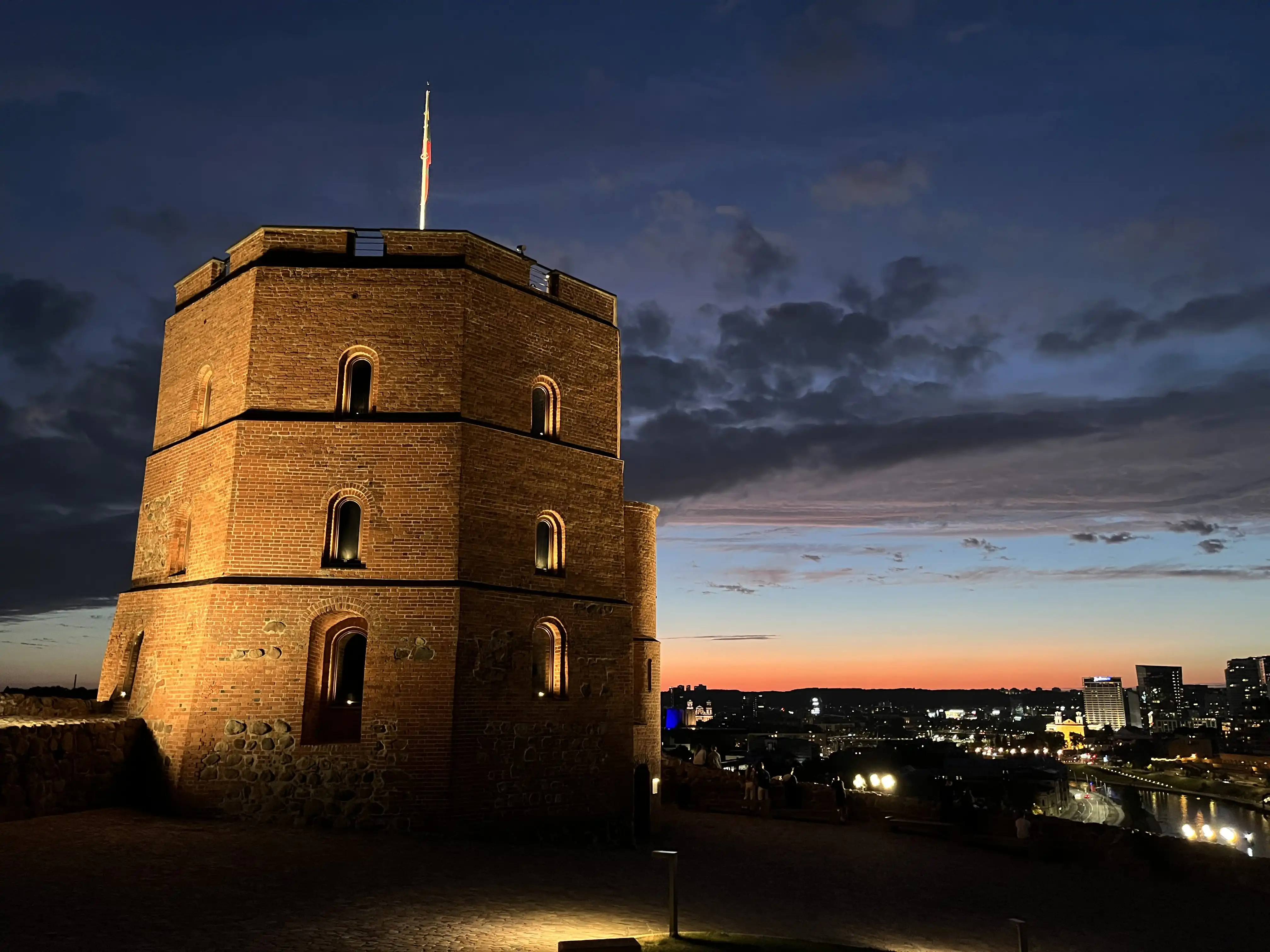
At sunset, I climbed Gediminas Hill with a cup of “Formosa” bubble tea. The Gediminas Tower and the Ducal Palace of the Upper Castle stand as an inseparable pair atop the hill. The octagonal red-brick tower, flying the Lithuanian flag, was a stronghold of nationalism in the late 20th century. More importantly, it was the starting point of the 1989 Baltic Way—a peaceful human chain of 2 million people stretching 675 kilometers to Tallinn, Estonia, a monumental moment for Baltic independence.
Nearby, the Upper Castle ruins stand in stark contrast to the opulence of the Lower Palace. While the latter was for social splendor, the Upper Castle symbolized defense and sovereignty. Destroyed during the 17th-century Russo-Polish War, it has been left in its ruined state ever since. Unlike Warsaw’s meticulous reconstruction, Vilnius chooses to coexist with its scars. There is a profound beauty in this incompleteness. Having witnessed centuries of gunpowder, the silence of the Soviet era, and the hope of the Baltic Way, these ruins represent a gentle compromise between time and freedom.
I sat on the stone wall by the tower, legs dangling, watching the sun dip below the horizon. I felt the breath of freedom and the passage of time, realizing that the hours I spent relaxing there represented decades of struggle for others.
As darkness fell, the pulse of jazz drums from below grew louder. I headed down to find a restroom and stumbled into an outdoor music bar. For a 5-euro “entry fee,” I stayed to enjoy a local band. Inside that “musical cave,” the crowd was a blur of dancing and raw energy—the true essence of a Vilnius night.
On my final day, I replaced my worn-out sneakers with a fresh, comfortable pair of white shoes and treated myself to some locally recommended sushi. For my final hours, I climbed the Hill of Three Crosses. Seeing parents and children gathered by the river, I realized school had started—yet here I was, refusing to stop, heading further and further North.
The irony? I realized at the last minute I’d booked my bus from the wrong station. I ended up racing through the streets on a Bolt e-bike, cursing the 25km/h speed limit. Miraculously, I made it. If you want to avoid my clumsy mistakes, check out my Vilnius Travel Guide!