EP 1. Where the Adventure Begins: My Escape to Budapest
First Steps in Europe
On my very first day in Europe, traveling solo, I boarded the famous FlixBus. Back then, I was naive enough to pay extra for two large checked bags—a fee I now look back on as a “tuition fee” for my arrival. And so, with a bit of a bumpy ride, I made my way to my exchange school in Brno, Czech Republic: Mendel University. The university was named in honor of Gregor Mendel, the father of genetics. It is said that right here in Brno, he conducted his famous pea plant experiments, turning the first page of modern genetics.
Stepping out in Brno, the first thing I saw was the chaotic central train station. It reminded me so much of Zhongli Station in Taiwan, but with a touch more elegance—a strange, beautiful blend of industrial grit and classical architecture.
I arrived in the Czech Republic having done zero homework. I figured there must be a bus to the dorms, right? Wrong. The main road had five or six parallel platforms that all looked the same on Google Maps. It took me forever, wandering around with broken English and frantic hand gestures, to find the right stop. Even after boarding, I had no clue how to buy a ticket or pay. With a backpack on my front, another on my back, and a suitcase in each hand, I eventually made it to the dorms. My first day in Europe, and I accidentally became a fare evader!
My roommate was a Chinese PhD student in his late twenties who had already lived in that dorm for three years. Everything you touched—the door handles, the fridge—felt greasy, and silverfish (or wood-boring insects) were a common sight in the room. Luckily, I have a fairly high tolerance for messiness; at least there are no cockroaches in the Czech Republic.
On my first day in Europe, everything seemed so expensive, though bread was surprisingly cheap. I walked to the supermarket behind the hill and spent 12 korunas on three buns for brunch. For dinner, I had some of my roommate’s leftover Thai basil pork (Gapao rice). It was a bit of a struggle on day one, but since my internal clock was still on Taiwan time, I wasn’t particularly hungry. Eating whatever was available felt fine—after all, it was already the middle of the night back home.
The Resonance Chamber: A Great Escape Born from Snoring
I have a high tolerance for mess, but my one deal-breaker is snoring. The moment I met my roommate, I began assessing the “snore potential.” He had the classic look—a large build that seemed built for resonance. If he doesn’t snore, we’re fine, I thought. He was polite enough to turn off the main lights at 9:00 PM and worked quietly, but at midnight, a thunderclap shattered the silence. He snored, and it was monumental. His back-sleeping posture allowed his “resonance chamber” to reach its full potential. It wasn’t a “steady output” type of snore; it was the “explosive roar” kind. And our beds were less than two meters apart.
After only three hours of sleep, I lay wide awake until dawn. The Czech summer nights were refreshingly cool—a level of comfort I’d never experienced before. Accompanied by the rhythmic thunder from across the room, my thoughts were agitated yet strangely accelerated. Right then and there, I made a snap decision: I was going to Budapest for two nights just to get some sleep.
Still clueless about how to buy tram tickets and loving the idea of exploring on foot, I walked over an hour from the dorm to the central station to catch a train to Budapest. I wasn’t even tired; the sights were constantly refreshing my brain’s “RAM.” Vast fields, passing faces of strangers—every unfamiliar sensation kept my mind in a state of high alert.
Wandering Budapest: Survival Rules by the Danube
Coming out of the Budapest train station, the city felt a bit gritty—trash everywhere and an underlying vibe that your pockets might get picked at any moment. My only goal here was a good night’s sleep. I checked into a cheap but clean hostel right next to a Lidl, where I stocked up on green grapes and mango ice cream. Realizing I had no utensils, I bought a knife—not just for the ice cream, but for a bit of “self-defense” peace of mind.
Even so, the second night wasn’t entirely peaceful. At 3:00 AM, the lights flickered on. A white man was screaming at an Indian man, accusing him of stealing a charger. From my top bunk, I didn’t even dare to peek. After a few tense minutes, someone finally told them to take it to the front desk. The Indian man looked genuinely innocent and didn’t even try to fight back. Was this discrimination? The question lingered in my mind.
Once I caught up on sleep, I marked a few spots on my map and started wandering. I stumbled upon a local city music festival: TE!Feszt 2024. It was intimate—two stages at opposite ends of the street. Kids were dancing at the small stage, while the main stage felt like a proper music fest. I caught some incredibly cool local bands over two days. Scoring a free music festival right after arriving in Europe felt like a total win.
My only “planned” activity was a Danube River cruise. The rest of the time, I lived on the “European budget starter pack”: bread, green grapes, and milk—things that are expensive in Taiwan but incredibly cheap here. I’d just find a park bench and enjoy a meal whenever I felt like it.
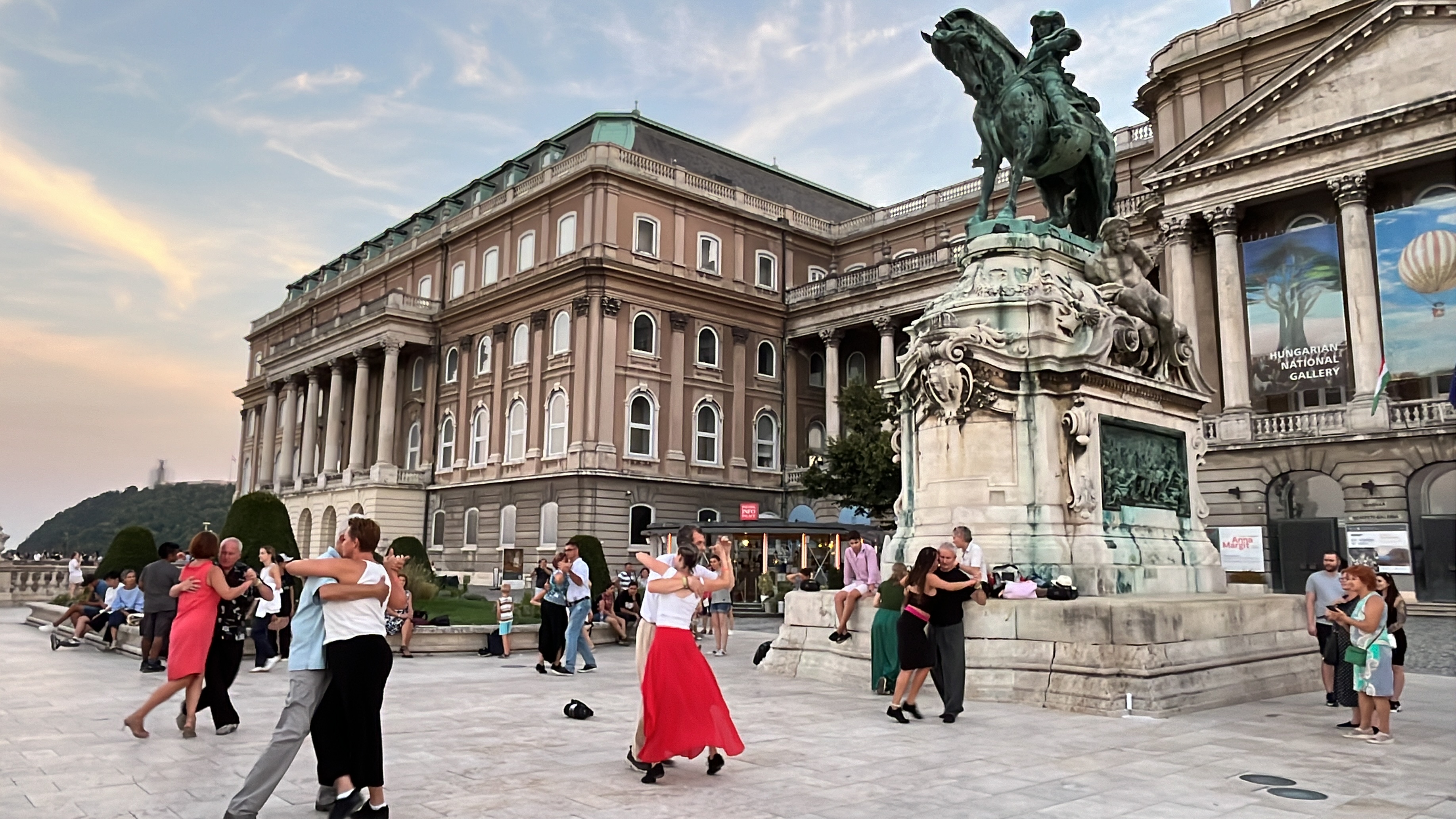
The grandeur of the Parliament at night, the views along the Danube, and my personal favorite—watching people dance at Buda Castle—defined my image of Central Europe. People say you’re either a “Vienna person,” a “Prague person,” or a “Budapest person.” At the time, I couldn’t imagine a city topping Budapest. While on the cruise, I chatted with two Filipinos who were doing the classic three-country route. They told me that for them, Vienna fit their definition of “beauty” far better than Budapest did.
The Missing WhatsApp and the Baltic Sea in Her Eyes
I met a girl from Hong Kong at the reception while she was checking in. I honestly can’t remember how we started talking, but we clicked instantly. Our conversation flowed from the lobby to the leafy common area on the second floor, spanning everything from travel and politics to culture and language. She had been on the road for a long time, heading south from the Baltics, and was leaving for Croatia the next morning.
She described the concentration camps in Kraków with such vividness it felt as if I were there, and insisted that Lithuania, Latvia, and Estonia were unmissable. She shared stories of “traveler serendipity”—how she’d run into the same people in different cities—and told me about the travelers she’d met, like a certain geography teacher. The details have faded, but her excitement remains. Before we parted, she offered to buy me a meal, we swapped WhatsApp info, and went back to our rooms.
I was supposed to head back to the Czech Republic the next day, but her stories sparked something in me. I decided to stay one more day and then booked a bus all the way north to Estonia. I even sorted the ferry to Finland and my flight back to mainland Europe. I wanted to tell her that I had decided to extend my journey, but no message ever came. When I checked my phone, I realized I hadn’t actually added her, or perhaps she hadn’t added me? To be honest, I didn’t even know how WhatsApp worked back then.
By the time I woke up the next morning at 10 AM, she was likely gone. There’s a special kind of familiarity in hearing your own language abroad. Although the specifics of our talk are blurry, I still remember the burning passion in her eyes as she shared her stories. I realized I didn’t fully understand her excitement yet—and that’s why I decided to keep going. I wanted to see for myself the Poland and the Baltics that lived within her words.